
FLE: delivering light to the mitochondria, not injuring the skin
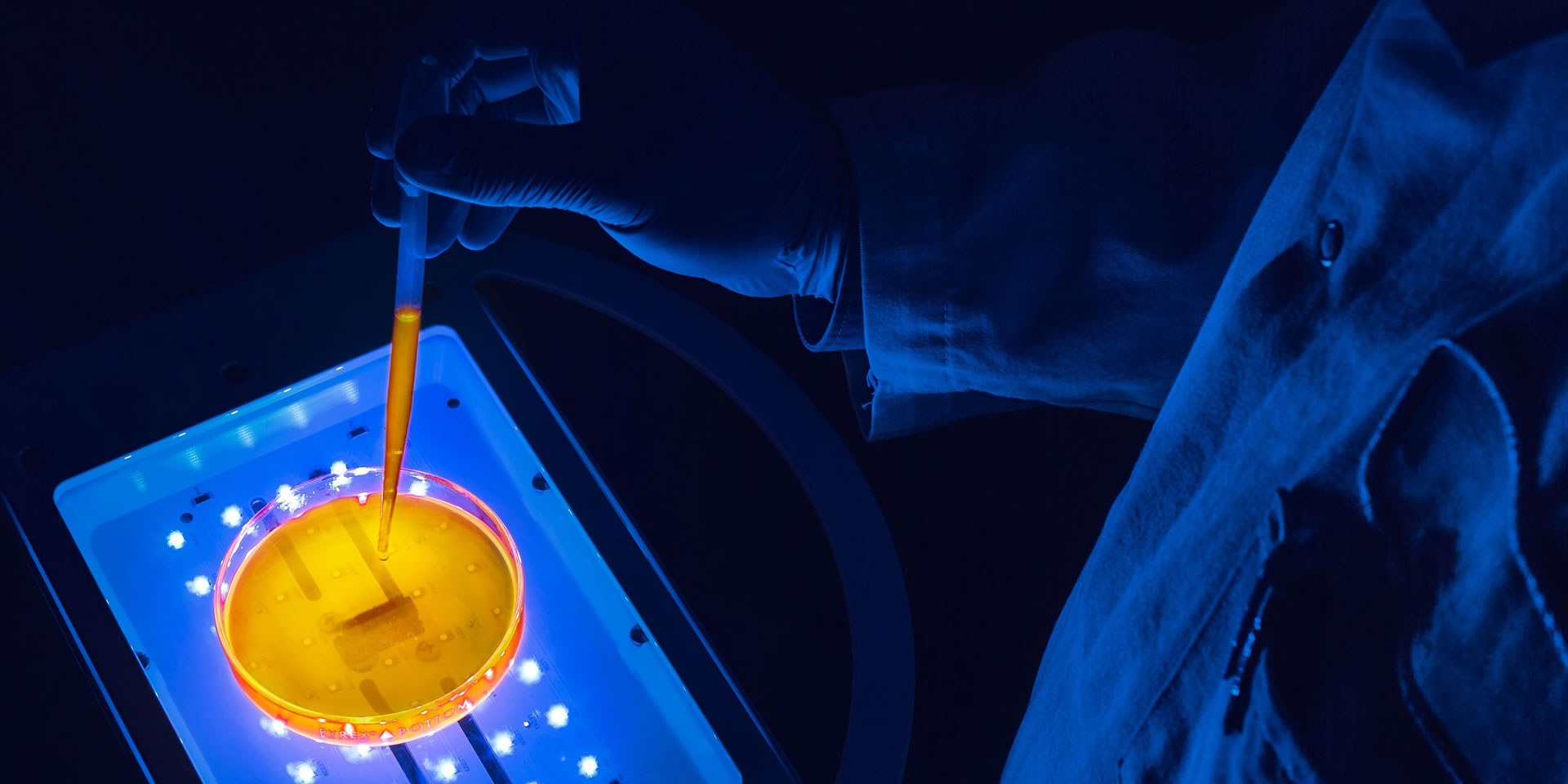
Also called Fluorescence Biomodulation. This is not a protocol that injures the skin and then waits for it to regenerate. A chromophore gel and a dedicated device deliver low-energy, polychromatic, dynamic fluorescence to the mitochondria.
FLE (Fluorescent Light Energy, also called Fluorescence Biomodulation) is the KLOX technology platform. Acne care, rejuvenation, rosacea, and wound care are built on the same mechanism. What differs is the indication, the product combination, and the regulatory class — not a different kind of light.
The mechanism in four steps
Chromophores in the gel
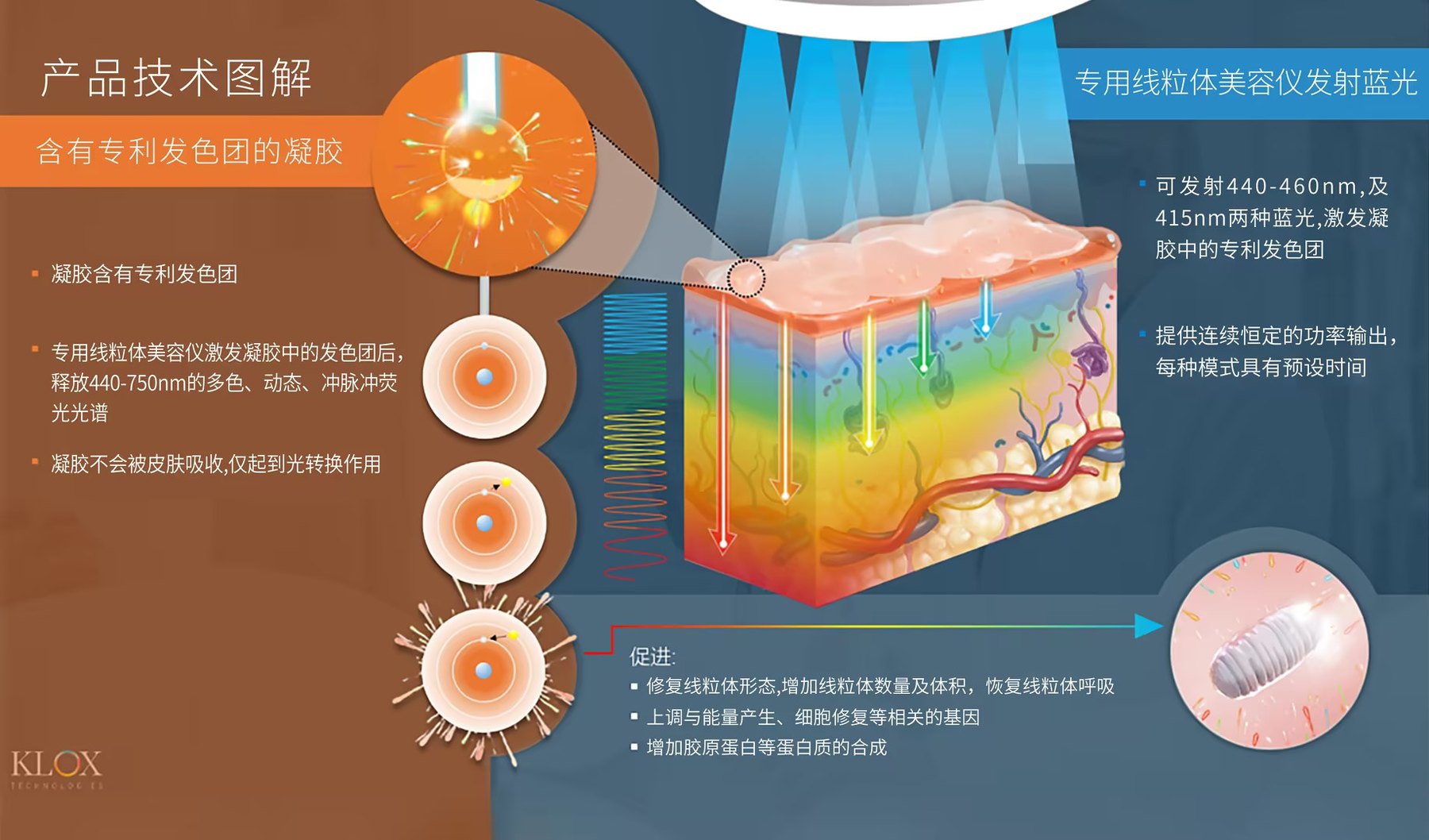
The photoconverting gel (also called a light-converting gel) contains patented chromophores. Treatment starts with the gel: the point is not a stronger light source, but first delivering excitable chromophores to the treatment site.
Device activation and the Stokes shift
After a dedicated device (also described on the official site as a regenerative-light device or a dedicated beauty device) illuminates the gel, the chromophores are excited, producing a Stokes shift and electronic transitions: light is absorbed at one wavelength and re-emitted at another, lower-energy wavelength. What reaches the skin is low-energy, polychromatic, dynamic, ultra-pulse fluorescence, not a single-wavelength, high-heat injuring beam.
Targeting compromised mitochondria, supporting ATP
This fluorescence targets compromised mitochondria. Mitochondria in skin cells convert the light into energy, activate genes involved in cellular repair and growth, modulate enzyme activity and electron transport, improve mitochondrial morphology, number, and function, and increase ATP production.
Controlling inflammation, supporting repair, and improving texture
On that basis, a biological cascade engages stem cells and immune cells at the same time, thereby helping control inflammation, support cellular self-repair, and improve skin texture, for aesthetic or therapeutic aims. Indications and clinical pathways differ, but this cellular mechanism is the same.
When briefing a partner, start with these three points
- This is a platform, not a single-product idea: explain FLE first, then acne care, rejuvenation, rosacea, or wound care.
- The treatment system is gel plus device.
- The key step is the Stokes shift after the chromophores are excited.
- The site of action is the mitochondria and ATP, leading to inflammation control and repair — not results obtained by injuring the epidermis.
Authorized in multiple countries and regions
Products have been authorized and marketed in countries and regions including the European Union, the United Kingdom, Canada, Israel, Australia, New Zealand, and Singapore. In 2021, the wound-care product LumiHeal® received U.S. FDA De Novo clearance — the first FLE-based device cleared by the FDA. The U.S. indication is to provide fluorescent and blue light to post-surgical incisions for scar management. In the same year, LumiHeal and Kleresca received NMPA authorization in China. For China medical-device or cosmetic classification of each product, see the indication pages. Where a registration number has not been verified, only the class is stated.
Multiple clinical studies have been published
There is a substantial published literature on FLE and related biophotonic protocols, covering acne vulgaris, rosacea, skin repair, and wounds. The papers below are selected from those already listed on the official Technology page, for professional readers to consult.
- Antoniou, Christina, et al. “A multicenter, randomized, split‐face clinical trial evaluating the efficacy and safety of chromophore gel‐assisted blue light phototherapy for the treatment of acne.” *International Journal of Dermatology* 55.12 (2016): 1321-1328.
- Nikolis, Andreas, et al. “An extension of a multicenter, randomized, split‐face clinical trial evaluating the efficacy and safety of chromophore gel‐assisted blue light phototherapy for the treatment of acne.” *International Journal of Dermatology* 57.1 (2018): 94-103.
- Russo, Antonio, et al. “Fluorescent light energy combined with systemic isotretinoin: A 52‐week follow‐up evaluating efficacy and safety in treatment of moderate‐severe acne.” *Clinical Case Reports* 9.4 (2021): 2057-2068.
- Sannino, Mario, et al. “Fluorescent light energy: treating rosacea subtypes 1, 2, and 3.” *Clinical Case Reports* 6.12 (2018): 2385.
- Wade, Martin, et al. “Biophotonic Therapy with Fluorescent Light Energy Decreases Facial Erythema, Improves Signs and Symptoms of Rosacea, and Increases Patient Satisfaction: A Postmarket Study.” *The Journal of Clinical and Aesthetic Dermatology* 14.7 (2021): 16.
- Nikolis, Andreas, et al. “A randomized, placebo-controlled, single-blinded, split-faced clinical trial evaluating the efficacy and safety of KLOX-001 gel formulation with KLOX light-emitting diode light on facial rejuvenation.” *Clinical, Cosmetic and Investigational Dermatology* 9 (2016): 115.
- Romanelli, Marco, et al. “Evaluation of fluorescence biomodulation in the real-life management of chronic wounds: the EUREKA trial.” *Journal of Wound Care* 27.11 (2018): 744-753.
- Ferroni, Letizia, et al. “Fluorescent light energy (FLE) acts on mitochondrial physiology improving wound healing.” *Journal of Clinical Medicine* 9.2 (2020): 559.
- Edge, Deirdre, et al. “Fluorescent light energy: the future for treating inflammatory skin conditions?” *The Journal of Clinical and Aesthetic Dermatology* 12.5 (2019): E61.
Partnership starts with a technical briefing
FLE (Fluorescent Light Energy, also called Fluorescence Biomodulation) is the KLOX technology platform. Acne care, rejuvenation, rosacea, and wound care are built on the same mechanism. What differs is the indication, the product combination, and the regulatory class — not a different kind of light.